The honest answer is "it depends on you", and that is no help when you are trying to budget. So here is the number everybody starts from, what moves it up or down, and what it adds up to in pounds.
The benchmark: 45 hours plus 22
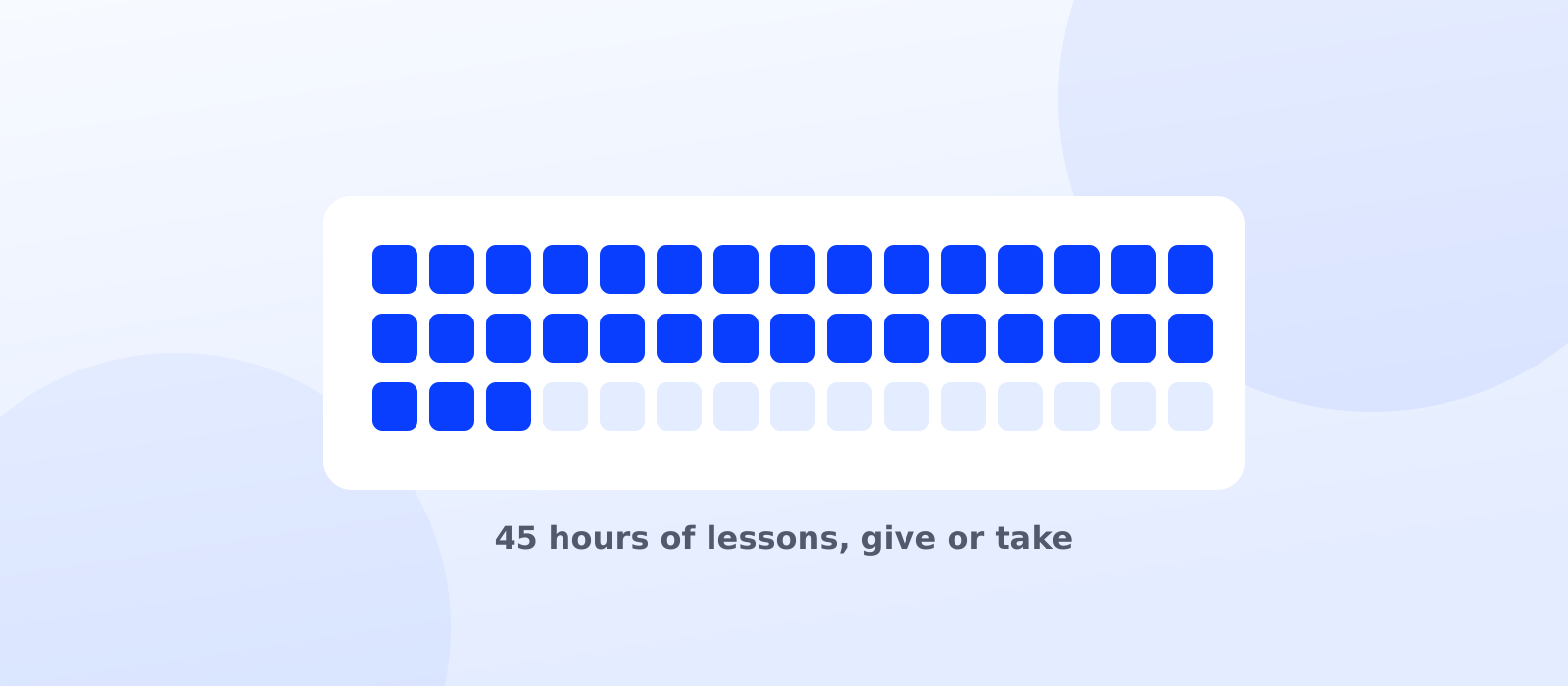
For years the DVSA has pointed to the same figure: learners who pass have had, on average, about 45 hours of professional lessons and about 22 hours of private practice with a friend or family member. It is an average, not a target, and there is no minimum number of lessons you have to take before the test. But it is the right place to start a budget, because most people land somewhere near it.
Spread across the range:
- 25 to 35 hours. Confident learners who practise between lessons, or who already drive abroad.
- 40 to 50 hours. Most people. Weekly lessons over eight to twelve months.
- 60 hours and more. Common, not a failure. Nervous drivers, people who had long gaps, people who started in a city.
What it costs
Instructors on Servicedrome charge a median of £40 an hour, with most between £37 and £45; outside London £33 to £38 is more usual. Learners posting lesson requests on the platform budget a median of £35.
| At £35 an hour | At £40 an hour | |
|---|---|---|
| 45 hours of lessons | £1,575 | £1,800 |
| Theory test | £23 | £23 |
| Practical test (weekday) | £62 | £62 |
| Provisional licence | £34 | £34 |
| Total | £1,694 | £1,919 |
A failed practical adds the test fee again, plus the lessons you take while waiting for the next date, which with current waiting times can be a couple of months. That is why the cheapest way through is not the cheapest instructor; it is passing first time. Our costs guide for London goes through the prices in more detail.
What makes it fewer
Two-hour lessons. The first twenty minutes of every lesson is the drive out to somewhere useful and the settling in. In a one-hour lesson that is a third of what you paid for. Two hours once a week beats one hour twice a week for most learners, and it is what most instructors recommend once you are past the basics.
Private practice. The 22 hours in the benchmark are not optional if you want the lower end of the range. You need a car, a supervising driver over 21 who has held a full licence for three years, and learner insurance on that car. The practice is for consolidating what the instructor taught, not for learning new things, so tell your supervisor what you covered and ask them to let you drive the same routes.
One instructor, no gaps. Every change of instructor costs a lesson or two of recalibration. Every month off costs more. If you are going to learn, learn weekly until the test. If you cannot afford weekly lessons for a stretch, pause completely and restart later rather than drifting to one every three weeks.
Automatic. You skip the clutch, gears and stalling, and most learners get to test standard in noticeably fewer hours. The trade is a licence that only covers automatics. We weigh it up in manual vs automatic. Five in six learners on Servicedrome who state a preference now ask for automatic.
Knowing the test routes. An instructor who works your test centre every week knows which roundabouts and which junctions catch people. Choose one who covers it; our guide to choosing an instructor explains how to tell.
What makes it more
Starting with a long gap since your last lesson, or in a city centre where the first ten lessons are mostly traffic. Learning in a car you will never drive again. Lessons at a different time every week, which makes it hard to build a routine. And, more than anything, booking the test too early: a test taken before you are ready is a failed test, a new fee, and more lessons while you wait.
Intensive courses
A week-long course of 20 to 40 hours with a test at the end is tempting with long waiting lists. It suits people who already have some hours and need to finish, or who learn best by immersion. It suits fewer complete beginners than the adverts suggest, and a test date is not guaranteed: the course provider has to find one, and in most of the country that is the hard part. Ask what happens to your money if no test is available.
How to plan it
- Get your provisional licence first (see before your first driving lesson).
- Book a theory test for six to eight weeks away and pass it early. You cannot book the practical without it.
- Find an instructor who covers your area and your test centre, and settle on a weekly two-hour slot.
- Around lesson 15 to 20, ask the instructor how many more they think you need. Instructors are good at this.
- Book the practical when the instructor says you are ready, not before, and keep the lessons going until the date.
If you are in London, where the longest waits in the country are, step 5 is the one to get right; see how to plan around the waiting times. Instructors in Bromley, Sutton and the other outer boroughs often know the quieter test centres as well as the busy ones.
Prices quoted are from instructors listed and lesson requests posted on Servicedrome in the twelve months to November 2026; test fees are the DVSA's at the time of writing and are on GOV.UK.