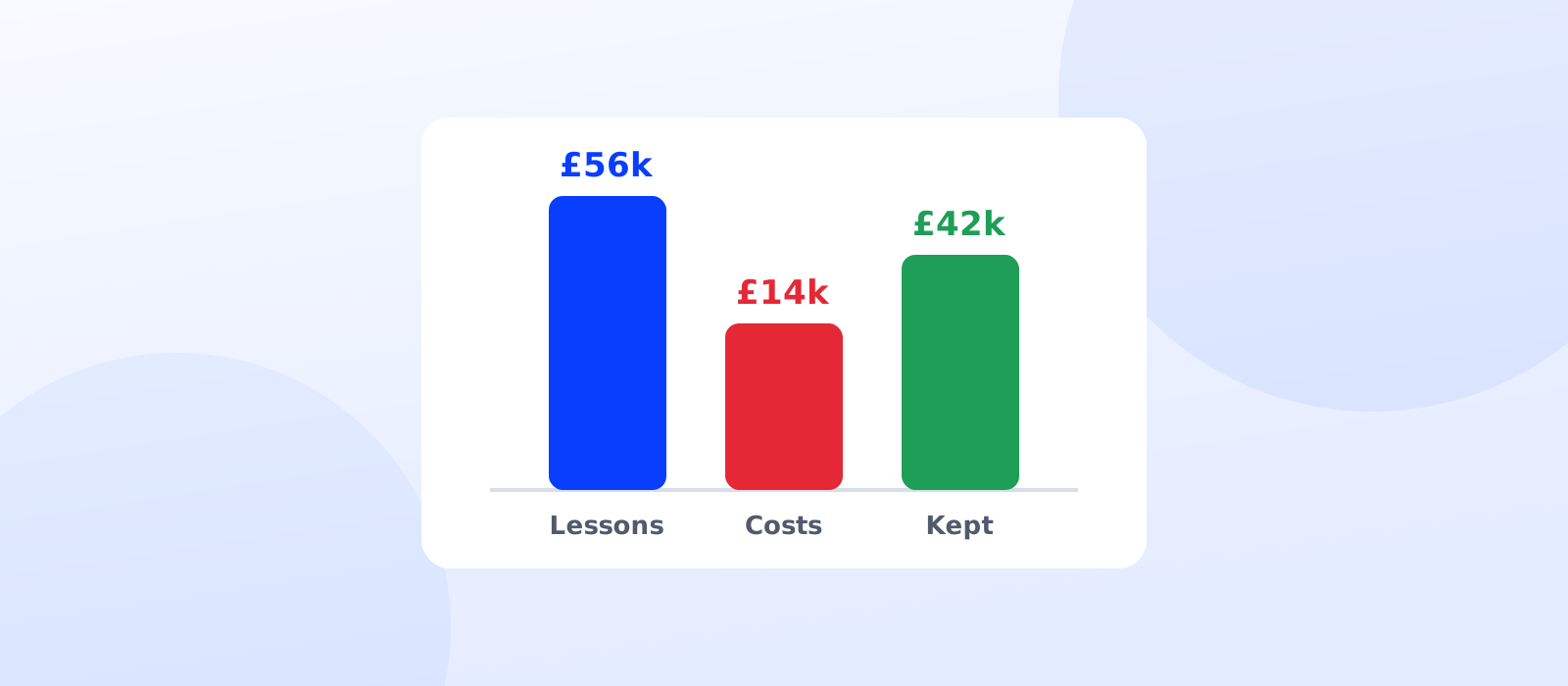
Search for "driving instructor salary" and you get three different answers: a job board average of about £25 an hour, a driving school's claim of £30,000 or more a year, and a forum thread where someone says they cleared far less. All three can be true. An instructor's income is a sum, not a salary, and the inputs vary a lot. This guide does the sum in the open so you can put your own numbers in.
Start with the hourly rate
Instructors listed on Servicedrome charge a median of £40 an hour for a standard lesson, with the middle half between £37 and £45. That is London-weighted; a 2022 government survey found almost half of ADIs nationally charging £31 to £35, and most national schools now advertise around £33 to £38. We go through where to set your own price in what to charge per hour.
For the sum below we use £40 for London and £35 for the rest of the country.
Then the hours you actually teach
This is the number everyone gets wrong. A 40-hour week is not 40 lessons. There is travel between pupils, the gap when someone cancels, the lesson that ends at a test centre 20 minutes from the next pick-up, and the admin. Most full-time instructors teach 25 to 35 hours a week, and most are off for four to six weeks a year once holidays, illness and the Christmas lull are counted.
| Full time | Part time | |
|---|---|---|
| Lessons taught per week | 30 | 15 |
| Weeks worked | 47 | 47 |
| Hours a year | 1,410 | 705 |
| Revenue at £40 (London) | £56,400 | £28,200 |
| Revenue at £35 (elsewhere) | £49,350 | £24,675 |
Keep this table in mind: the biggest lever on an instructor's income is the taught-hours row, not the price row. Going from 22 hours a week to 30 at £40 is worth about £15,000 a year. Raising the price by £2 is worth about £2,800.
Now the costs
These are the ones every instructor pays, with the ranges we see quoted at the time of writing. Put your own in.
The car. A dual-control lease is the simplest option: the big schools and specialist lessors quote roughly £125 to £180 a week, and the higher figure usually includes instructor insurance and breakdown cover. That is £6,500 to £9,400 a year. If you own the car outright, swap in depreciation, servicing, tyres and the dual-control fitting instead; it is rarely much cheaper over five years.
Insurance. Standalone driving instructor insurance is quoted at about £1,200 to £2,000 a year, depending on your area, the car and how many hours you teach. Skip it if the lease includes it.
Fuel. A full diary burns roughly 300 to 400 miles of lessons a week in a city, more in the country. Call it £60 to £80 a week, so £2,800 to £3,800 a year. Electric cars cut this a lot if you can charge at home.
The DVSA. Your ADI registration is £300 every four years, so £75 a year, plus the standards check you sit at least once in that period.
Everything else. Phone, a diary app, a card reader, accountancy, the odd road sign and cone set. Budget £500 to £1,000.
Finding pupils. This is the cost that varies most. A driving school franchise is £150 to £250 a week, £7,800 to £13,000 a year, sometimes with the car included, in which case take the lease off the line above. Going independent and finding pupils through word of mouth and lead marketplaces costs a fraction of that, but it is not free either. We compare the two in franchise or independent.
The sum, full time in London
| Franchise, car included | Independent, leased car | |
|---|---|---|
| Revenue (30 hrs × 47 wks × £40) | £56,400 | £56,400 |
| Franchise fee | −£10,400 | – |
| Car lease with insurance | included | −£8,500 |
| Fuel | −£3,300 | −£3,300 |
| DVSA, phone, admin | −£900 | −£900 |
| Finding pupils (leads, cards, website) | included | −£1,500 |
| Profit before tax | £41,800 | £42,200 |
The two routes land in a similar place at a full diary. The difference is what happens when the diary is not full: the franchise fee is due in the quiet weeks, and the lead cost is not. In a 22-hour week the franchise instructor's profit is roughly £26,000; the independent's is roughly £28,000, and it is the independent who can cut their pupil spend to zero for a month if they want to.
And after tax
Income tax and Class 4 National Insurance come off the profit. On £42,000 of profit in 2026/27 a sole trader keeps something like £33,000 after both, depending on the personal allowance and NI thresholds in force, which change each April. Check the current figures on GOV.UK or with an accountant rather than taking that number as fixed.
So the honest range for a full-time instructor with a full diary is around £30,000 to £35,000 a year in hand, and a part-time instructor teaching 15 hours a week takes home something like £14,000 to £17,000 once the fixed costs of the car are spread over fewer hours. The fixed costs are why part-time instructing pays less per hour than full-time: the car costs the same whether it teaches 15 lessons or 30.
What moves the number most
- Taught hours. Fewer gaps, less dead travel, fewer cancellations. A tight cancellation policy matters here more than anywhere.
- Pupil cost. Every pupil you get from word of mouth or a review on your profile is one you did not pay a weekly fee to find.
- Price. Worth a few thousand a year, and easiest to raise once you have reviews.
- The car. The gap between a £125 lease and a £180 lease is £2,800 a year.
If you teach in London, the revenue side is higher and so is the fuel bill; the busiest requests on Servicedrome in the last three months were in Islington, Camden and Westminster. Outside London the rate is lower and so are the costs, and the sum tends to end up within a few thousand pounds of the same place.
Figures for lesson prices are from instructors listed on Servicedrome in November 2026. Lease, insurance and franchise ranges are from prices publicly advertised at the time of writing and will drift; tax figures are illustrative only.